Build the Seven Diatonic Triads of a Major Scale
Stack alternate scale degrees to form a triad on each note. The resulting chord qualities follow a useful pattern, but verify the notes so that the pattern has a musical explanation.
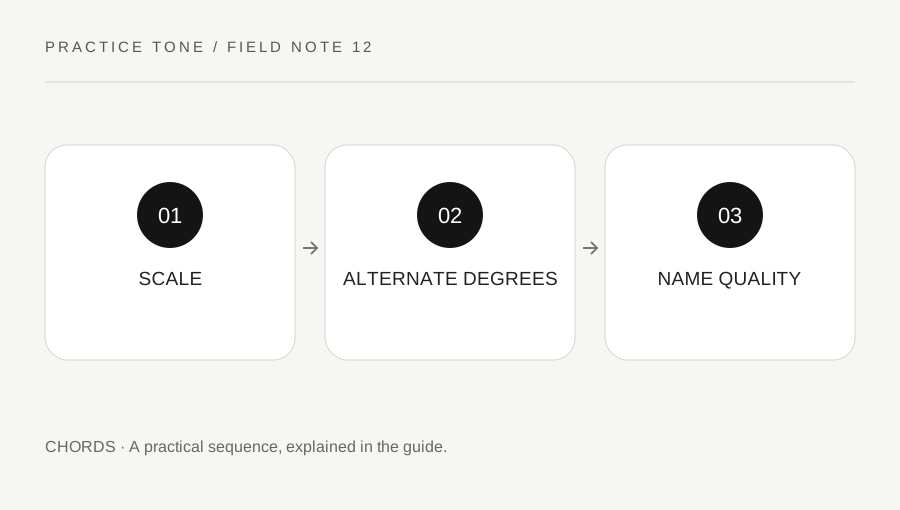
Original explanatory diagram. Numerical examples in this guide illustrate the reasoning; they are not a claim of hands-on testing.
Start with one complete major scale
Write C major as C, D, E, F, G, A and B. To build a triad on a scale degree, choose that note and then every other scale note above it. Starting on C gives C–E–G. Starting on D gives D–F–A. Continue the scale into the next octave when you reach the end of the written list.
Diatonic here means using notes from the chosen scale collection. Do not add F-sharp to the D chord just because D major is familiar as a separate chord. Within C major, the selected F is natural, producing a D-minor triad.
Keep the scale spelling visible beside the chord list. This prevents a memorized chord shape from silently changing the note collection and lets you check each triad as a relationship among scale degrees.
Determine quality from the intervals
C–E–G has four half steps from C to E and seven from C to G, so it is major. D–F–A has three half steps to F and seven to A, so it is minor. B–D–F has a minor third and a diminished fifth, six half steps from B to F, making it diminished.
The seven qualities in a major scale are major, minor, minor, major, major, minor and diminished. Roman numerals often write them as I, ii, iii, IV, V, vi and vii°. Capitalization helps indicate major or minor, and the small circle marks diminished.
These symbols are a naming aid, not a replacement for note knowledge. Read the actual chord tones and explain the third and fifth when checking a quality. The explorer supports major and minor triads but does not include a diminished-triad playback option.
Transpose the method rather than only the chord list
G major is G, A, B, C, D, E and F-sharp. Its triads are G major, A minor, B minor, C major, D major, E minor and F-sharp diminished. The F-sharp belongs to the scale and therefore appears wherever that degree is used in the stacked triads.
For a worked chord, build the triad on D using alternate G-major notes: D–F-sharp–A, which is D major. Compare it with D–F–A from C major. The same chord root can have a different diatonic quality in a different scale context.
Write one triad fully before naming it. If the quality pattern and your notes disagree, inspect the parent scale and the alternating-letter step rather than changing the label to make the list look correct.
Use a small original progression
In C major, play C major, A minor, F major and G major, one chord per bar. The scale-degree labels are I–vi–IV–V. This original practice progression illustrates the chord collection without copying a song arrangement. Use comfortable voicings and a simple pulse.
Then transpose the functions to G major: G major, E minor, C major and D major. The chord names change while the scale-degree relationship remains. Play slowly enough to name the tones of each chord and hear the return toward the tonic.
Finish by building the triad on degree two of F major. The notes G–B-flat–D produce G minor. Explain the B-flat from the parent scale rather than recalling the answer in isolation. This method gives you a way to reconstruct the diatonic collection whenever a memorized chart is unavailable.
A practical checklist
Tick items for your own use. This checklist is saved only in this browser.
Questions that come up
Is every chord with root D a D-major chord?
No. D–F–A is minor and D–F-sharp–A is major. The actual third determines the difference.
Does the tool play the diminished seventh-degree triad?
No. It supports major and minor triads. The diminished chord in this guide is a written and instrument exercise.
Does diatonic mean a piece cannot use other notes?
No. This exercise defines a scale-based collection. Real music can use chromatic notes and chords for many purposes.
References & scope
Background references checked on 18 October 2026. The examples and practice exercises are original editorial explanations, not copied procedures or professional advice.