Find Piano Note Names Using the Two-and-Three Black-Key Pattern
The repeating black-key groups provide dependable landmarks. Learn the letter sequence and the adjacent half steps before trying to recognize every note instantly.
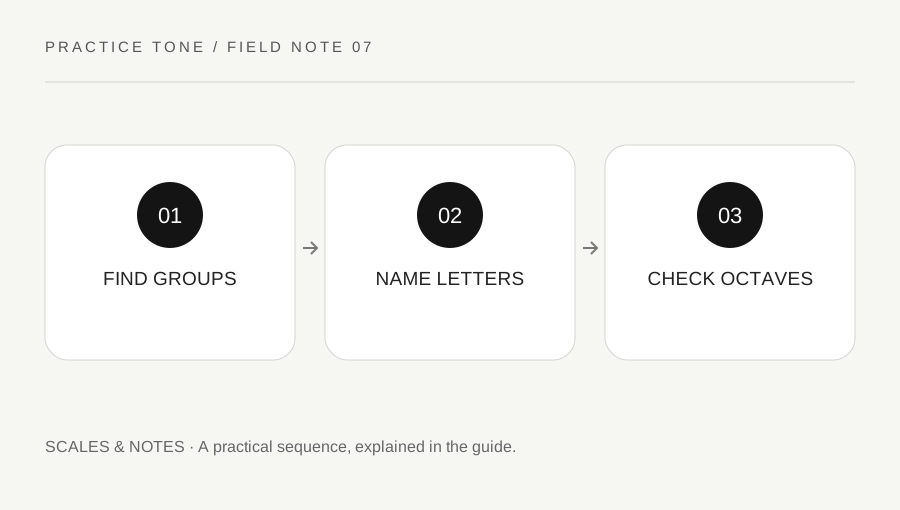
Original explanatory diagram. Numerical examples in this guide illustrate the reasoning; they are not a claim of hands-on testing.
Locate a group rather than the keyboard’s end
Look for two black keys close together, then three. The white key immediately to the left of a two-black-key group is C. This landmark repeats across the keyboard, so you do not need to count from its lowest end or rely on a sticker at one location.
Starting from C, move through adjacent white keys and name C, D, E, F, G, A, B, then C again. The letters restart after G rather than continuing alphabetically. Say the sequence slowly while pointing without playing if coordinating speech and sound is initially distracting.
Find three different Cs using the black-key pattern. Check that each has the same relationship to a two-key group. Their pitches differ by octaves, but the letter name repeats. A keyboard with fewer keys still preserves the internal pattern even if it starts partway through a group.
Connect black keys with neighboring white keys
The black key between C and D can be called C-sharp or D-flat in twelve-tone equal temperament. Sharp raises the named note by a half step, and flat lowers it by a half step. The chosen spelling depends on musical context, not on whether your hand approaches from the left or right.
There is no black key between E and F or between B and C. Those adjacent white-key pairs are already half steps apart. A whole step spans two adjacent half steps, so C to D is a whole step while E to F is not.
Avoid a rule that every sharp must be a black key. E-sharp uses the same equal-tempered key as F, and C-flat the same key as B. These spellings preserve musical letter relationships in certain scales and chords.
Practice finding notes in a small register
Choose a comfortable region near the keyboard center. Find C, then E, then G, using the letter sequence and landmarks as needed. Play them separately and notice that their sound depends on register as well as name. Moving all three up an octave retains their pitch-class relationships while changing their absolute pitches.
Use the explorer's C-major triad as a note-name check, but do not assume its synthesized register matches every physical keyboard exercise. The display names pitches; it does not tell you which finger must play them.
For a short task, locate F from the three-black-key group: it is the white key just before that group. Then name the white keys through B. Compare this route with counting upward from C, and choose the landmark that makes each target easier to find without rushing.
Read a note name as a location to verify
Write six targets on paper: C, F, A, D-flat, F-sharp and B. Find each slowly, name its neighboring white keys and check the black-key group. Then reverse the task by touching a key and naming it. These are different retrieval directions, so practice both.
If you confuse B and C, return to the half-step boundary instead of adding more targets. If black-key names are uncertain, state both adjacent-letter names and explain why the same key can have two spellings. Keep the distinction between a key on the instrument and a note's written musical function.
Finish by playing two Cs in neighboring octaves and describing what stayed the same and what changed. The letter and pitch class repeat, while one pitch is higher. A dependable landmark method provides a foundation for scale and chord learning without requiring instant recognition on the first session.
A practical checklist
Tick items for your own use. This checklist is saved only in this browser.
Questions that come up
Is every C the same pitch?
The letter repeats across octaves, but the absolute pitches differ. The higher C has twice the frequency of the next lower C in the standard equal-tempered octave relationship.
Is C-sharp always different from D-flat on this tool?
They share a pitch class in its twelve-tone equal-tempered playback. Their spellings describe different musical functions.
Do I need note stickers?
Landmarks can help you learn independently. If you use labels temporarily, keep practicing the black-key pattern so finding notes does not depend entirely on the labels.
References & scope
Background references checked on 18 October 2026. The examples and practice exercises are original editorial explanations, not copied procedures or professional advice.