Major and Minor Triads: Hear What the Third Changes
A triad contains three distinct chord tones. Build a major and a minor version from the same root, then compare the one note that changes while the root and fifth remain fixed.
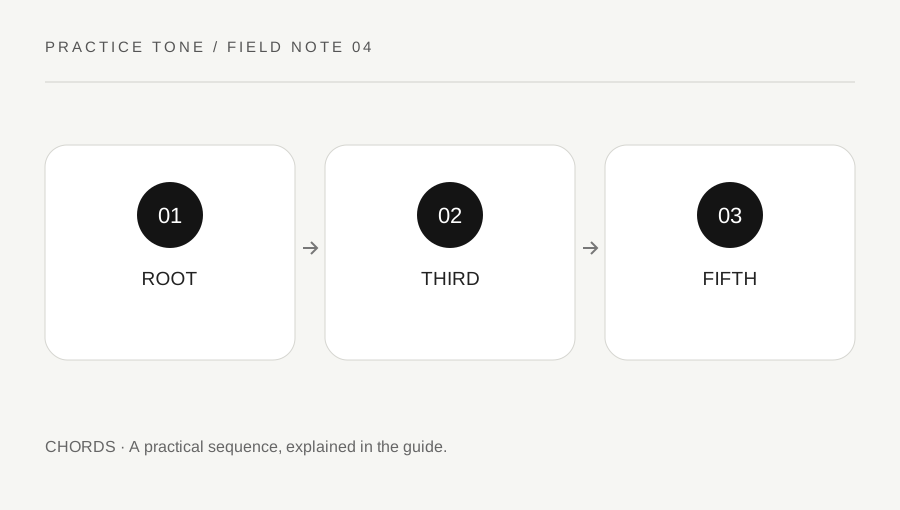
Original explanatory diagram. Numerical examples in this guide illustrate the reasoning; they are not a claim of hands-on testing.
Build from a root rather than a hand shape
Start with C as the root. A C major triad contains C, E and G: root, major third and perfect fifth. Measured upward from C in half steps, those positions are zero, four and seven. Play them one at a time before sounding them together so that the chord does not become an unexplained block of sound.
On piano, locate the three named keys in a comfortable register. On guitar, a chord shape may repeat one of those notes on several strings. Repeated roots or fifths do not create extra distinct chord tones. A six-string grip can still be a triad if its sounding notes belong only to C, E and G. The musical identity depends on the notes and their relationships, not the number of strings used.
Change the third to make a minor triad
Lower E to E-flat while keeping C and G. The result is C minor: root, minor third and perfect fifth. The half-step positions from the root become zero, three and seven. Compare C–E–G with C–E-flat–G slowly, first as broken chords and then as simultaneous sounds.
Avoid treating “major means happy, minor means sad” as a complete explanation. Those words can describe one listener's impression in one context, but tempo, register, rhythm, voicing and surrounding harmony all influence the result. For a reliable identification task, attend to the interval structure. Ask whether the third lies four or three half steps above the root rather than trying to force every chord into an emotional label.
Transpose the same relationship
From G, count four half steps to B and seven to D. G major is G–B–D. Lower the third to B-flat for G minor, G–B-flat–D. From A, the major triad is A–C-sharp–E and the minor triad is A–C–E. The interval formulas stay the same even though the physical pattern of black and white piano keys changes.
Write the note names before playing. This prevents a remembered shape from substituting for the concept. The explorer offers all twelve roots and conventional triad spelling. A note such as E-sharp may appear in a key where the chord's third requires the letter E; in equal temperament it shares the piano key named F, but the spelling preserves the root–third–fifth letter relationship.
Separate chord identity from note order
C–E–G with C lowest is root position. E–G–C with E lowest is first inversion, and G–C–E with G lowest is second inversion. These contain the same three pitch classes but place a different chord tone in the bass. The explorer's basic triads use root-position playback for an easy first comparison.
Try changing the order on a keyboard without changing the notes. Listen for a difference in spacing and bass while retaining the C-major identity. On guitar, do not assume the lowest physical string always supplies the named chord root; some strings may be muted and inversions can place another chord tone lowest. Check the actual sounding notes rather than the visual outline of the grip.
Use a short listening and naming routine
Choose C major and C minor in the explorer. Listen to each once while reading the notes, then look away and sing or imagine the middle chord tone before replaying. Repeat with A major and A minor. Keep volume comfortable and compare just two qualities rather than adding many chord types immediately.
Finish with a written task: name D major, D minor, F major and F minor. The answers are D–F-sharp–A, D–F–A, F–A–C and F–A-flat–C. For each pair, underline only the third. If you can explain which note changed and why, you have a transferable method for constructing triads rather than a list of isolated chord shapes to memorize.
A practical checklist
Tick items for your own use. This checklist is saved only in this browser.
Questions that come up
Is a chord with six sounding strings still a triad?
It can be. The strings may duplicate the three chord tones in different octaves. Count distinct chord tones rather than strings.
Does inversion change major into minor?
No. Reordering the same chord tones changes the bass and voicing, not the triad quality.
Does the explorer recognize my played chord?
No. It generates selected notes in the browser. It does not use a microphone, analyze recordings or listen to your instrument.
References & scope
Background references checked on 18 October 2026. The examples and practice exercises are original editorial explanations, not copied procedures or professional advice.