Triad Inversions: Keep the Notes, Change the Bass
An inversion changes which chord tone is lowest. Compare three arrangements of the same triad, then use nearby notes to connect two chords without unnecessary leaps.
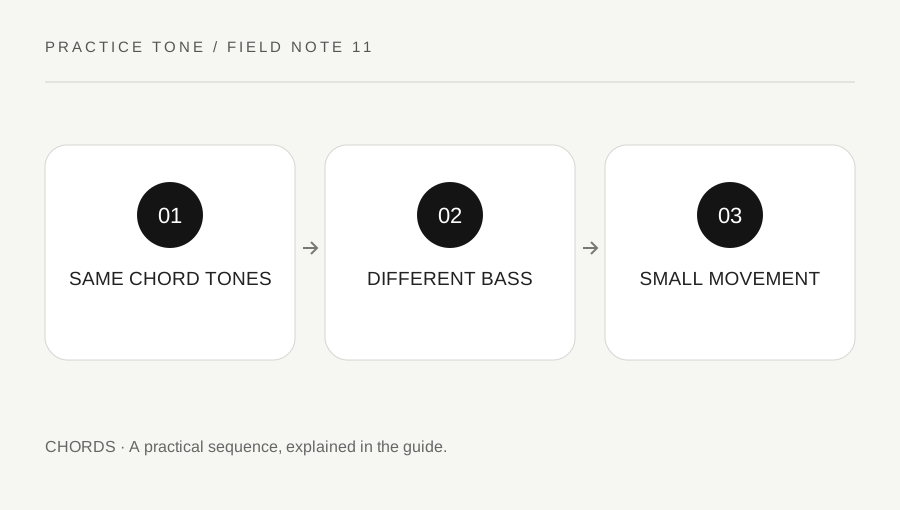
Original explanatory diagram. Numerical examples in this guide illustrate the reasoning; they are not a claim of hands-on testing.
Separate chord tones from their order
C major contains C, E and G. In root position, C is lowest. In first inversion, E is lowest, and in second inversion, G is lowest. The three arrangements retain the same pitch classes and major quality, even though the bass and spacing change.
Write the bass note explicitly when practicing. The label first inversion does not mean the first note written on the page or the first finger used. It refers to the chord's third in the bass. Likewise, second inversion places the fifth lowest.
Doubling a chord tone in another octave does not by itself change the inversion. A voicing with C, G, C and E still has C as its bass and remains root position. Identify the lowest actual sounding pitch rather than counting notes from left to right in a chord diagram.
Find three comfortable keyboard versions
In a suitable register, play C–E–G, then E–G–C, then G–C–E. Use comfortable fingering and do not force the hand to span an uncomfortable distance. These close-position examples make the bass change easy to hear.
The explorer provides basic root-position triad playback only. Use its note spelling to check the chord tones, then rearrange them on your instrument. It does not automatically generate every inversion or determine a piano fingering.
Play each arrangement slowly as a broken chord before sounding the notes together. Listen for the same three pitch classes and the different lowest tone. If one note changes to another pitch class, you have changed more than inversion and should check the intended target before evaluating how the voicing sounds.
Use a nearby inversion to connect chords
Compare C major with A minor. C–E–G can move to C–E–A, retaining C and E while moving G to A. The second chord is A minor in first inversion because C, its third, is lowest. This small movement provides one example of voice leading.
Another route can use different registers or bass goals, so the smallest possible movement is not a universal requirement. It is a practice constraint that helps you notice shared tones and independent parts. Write the chosen starting and destination notes before playing.
On guitar, a chord shape may contain repeated notes and muted strings. Check which note actually sounds lowest; the physically lowest string may be silent. Inversion labels describe sounding pitches, not a grip's visual location on the neck.
Check a new triad and build a short sequence
For D minor, the chord tones are D, F and A. Root position can be D–F–A, first inversion F–A–D and second inversion A–D–F. Name the bass in each before playing. The minor quality stays because the same three pitch classes remain.
Create an original two-chord exercise using C major and F major. Compare C–E–G moving to C–F–A with a larger root-position jump. Both can be musically valid. Describe which voices move and which remain, rather than deciding solely that one shape feels easier.
Finish by explaining inversion in one sentence: the chord identity stays while a different chord tone occupies the bass. Then add a separate sentence about voicing, which also includes spacing and doubling choices. Keeping those concepts related but distinct makes later chord-symbol reading and accompaniment practice clearer.
Check G major as another example: G–B–D is root position, B–D–G first inversion and D–G–B second inversion. Explain the bass note in each without changing the major third B to B-flat.
A practical checklist
Tick items for your own use. This checklist is saved only in this browser.
Questions that come up
Does playing a chord higher make it an inversion?
Not necessarily. Moving an entire root-position chord up an octave retains its root in the bass. Inversion depends on which chord tone is lowest.
Does the explorer play every inversion?
No. Its basic triads use root-position playback. Rearrange the displayed tones on an instrument for this exercise.
Can a triad include more than three sounding notes?
Yes. A voicing can double its three pitch classes in other octaves. Inversion still depends on the lowest sounding chord tone.
References & scope
Background references checked on 18 October 2026. The examples and practice exercises are original editorial explanations, not copied procedures or professional advice.