Syncopation: Keep the Beat While the Sound Lands Elsewhere
A rhythm can emphasize an offbeat without moving the underlying pulse. Use a clear subdivision grid and one pitch to distinguish deliberate displacement from an accidental late entry.
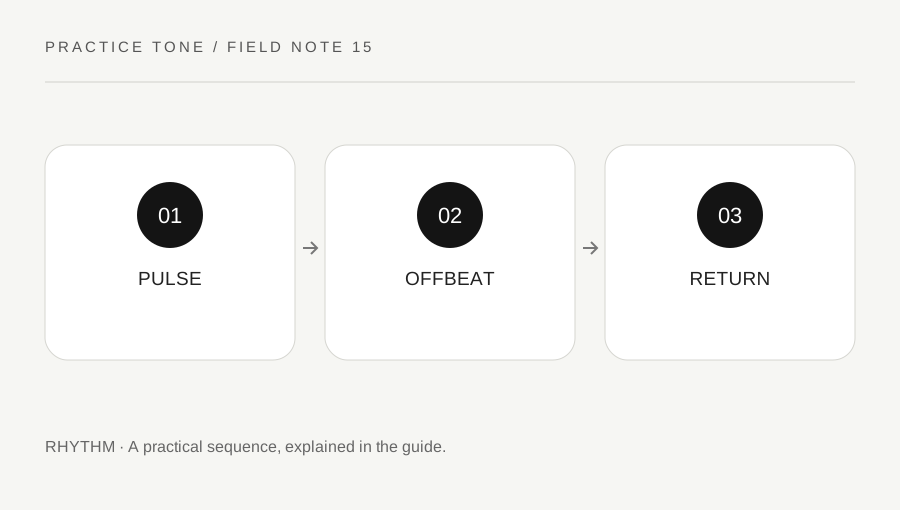
Original explanatory diagram. Numerical examples in this guide illustrate the reasoning; they are not a claim of hands-on testing.
Establish a dependable grid first
Set a simple 4/4 pulse and count “one and two and three and four and.” The numbered positions meet the quarter-note clicks. The “ands” fall halfway between. Before adding an offbeat pattern, speak and tap this grid evenly for several bars.
Syncopation can involve emphasis or continuation across expected beat accents. The introductory exercise here focuses on offbeat entries so that the underlying count remains easy to follow. It does not claim to cover every syncopated style or notation pattern.
If the subdivisions are uneven before the pattern begins, simplify the task. A syncopated sound should occupy a deliberate place in time, not be labeled syncopation merely because it happened late. Listening to the click while keeping the grid steady provides a reference for the difference.
Sound only the offbeats
Clap on each “and” and remain silent on the numbered beats. Keep saying all eight positions. At first, a quiet foot or hand pulse on the numbered beats may help, but use it only if the coordination stays comfortable.
Listen for equal spacing from one offbeat to the next and for the unchanged relationship to the clicks. The first offbeat follows beat one by half a beat. If you begin immediately with the first click, you have moved the pattern onto the beat rather than performing the stated exercise.
Use a full count-in before starting. If the count becomes uncertain, stop and rejoin after listening rather than shifting the pattern to match the next convenient sound. A deliberate reset protects the musical grid and makes the next attempt easier to assess.
Add a held sound across a beat
Try an original one-bar pattern with a sound on beat one, then a sound on two-and held through beat three, followed by a sound on beat four. Keep counting three even though no new attack occurs there. The held sound changes where the attacks and emphasis occur without removing the beat from the bar.
On piano or guitar, decide how you will sustain and release the note. An accidental gap can change the rhythmic effect. Practice on one comfortable pitch so that chord changes do not conceal the timing question.
If reading notation, learn the difference between a tie joining durations and separate repeated attacks. This written counting exercise describes the timing explicitly but is not a substitute for a complete notation lesson. Mark the attack positions and the continuing sound in different ways.
Review the return to a clear downbeat
Repeat the bar twice and return to a simple note on every numbered beat. The pulse should continue without a tempo change. If you rush the transition, practice only the final beat of the syncopated bar and the first beat of the next bar.
For a worked self-check, record which attack was intended on two-and and whether it remained halfway between clicks two and three. Describe an early or late placement rather than calling the entire attempt wrong. That narrower observation suggests a useful correction.
Finish by distinguishing the beat from the rhythm played over it. You can stop making sound, sustain through a beat or enter between beats while the underlying count continues. This separation supports more complex accompaniment later, but it begins with an even grid, a simple sound source and an explicit place to return.
For another check, tap only the numbered beats while speaking the offbeat attacks. If the tapping changes speed, rebuild the underlying pulse before asking the instrument to carry the displaced rhythm.
A practical checklist
Tick items for your own use. This checklist is saved only in this browser.
Questions that come up
Is every note between clicks syncopated?
Not necessarily. Syncopation concerns rhythmic emphasis and expectation. Offbeat clapping is a controlled beginner exercise, not a complete definition of every musical use.
Should I move the click to match my offbeat?
Keep the stated quarter-note reference for this exercise. The task is maintaining the offbeat relationship, not relabeling a late sound as a new beat.
Can I practice without an instrument?
Yes. Spoken counting and quiet clapping isolate the rhythm before instrument technique adds another variable.
References & scope
Background references checked on 18 October 2026. The examples and practice exercises are original editorial explanations, not copied procedures or professional advice.