Build a Major Scale From Whole Steps and Half Steps
A major scale is defined by its interval pattern, not by using only white piano keys. Start on a chosen tonic, follow the distances and give each scale degree a clear name.
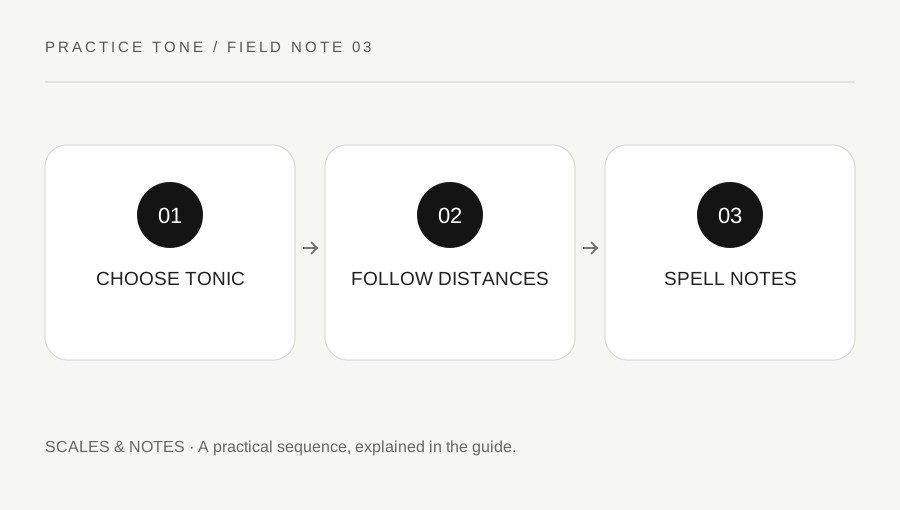
Original explanatory diagram. Numerical examples in this guide illustrate the reasoning; they are not a claim of hands-on testing.
Use the keyboard to see adjacent pitches
On a piano keyboard, a half step is the distance from one key to the next immediately adjacent key, including black keys. E to F and B to C are half steps even though both keys are white. C to D is a whole step because C-sharp or D-flat lies between them.
On a standard fretted guitar, one fret changes pitch by a half step along the same string. Two frets make a whole step. This distance model helps connect the instruments, but it does not determine comfortable fingering. Begin by naming and hearing a few adjacent pitches before trying to race through a memorized hand shape. Keep physical movement relaxed and stop if practice causes discomfort.
Follow the major-scale sequence
From the tonic to its octave, the major-scale distances are whole, whole, half, whole, whole, whole, half. Starting on C produces C, D, E, F, G, A, B, C. The half steps occur between the third and fourth scale degrees and between the seventh degree and the octave.
Say the scale-degree numbers while playing slowly: one through seven, then one again at the octave. The final C has the same letter name as the starting C but a higher pitch. The pattern contains seven distinct pitch classes before repeating the tonic. If you accidentally insert a whole step between E and F in C major, you have changed the pattern and are no longer building that major scale.
Move the pattern to G and F
Starting on G gives G, A, B, C, D, E, F-sharp, G. The F must be raised to keep a whole step from E to the seventh degree and a half step into G. Starting on F gives F, G, A, B-flat, C, D, E, F. B-flat supplies the required half step from the third degree A to the fourth degree.
Use one of these scales as a worked comparison with C major. Point to the interval that would fail if every white key were used. The purpose of the sharp or flat is to preserve the scale structure. A scale with a black key is not a more advanced kind of major scale; it applies the same interval pattern from a different starting pitch.
Give each degree its own letter
A conventionally spelled major scale uses each letter A through G once before the octave, with accidentals added as needed. F major therefore uses B-flat rather than A-sharp, even though those pitches share a key in twelve-tone equal temperament. The spelling shows the sequence F, G, A, B, C, D, E clearly.
The explorer uses twelve-tone equal-tempered playback and spells its selected major and natural-minor scales by scale degree. Those names describe pitches, not a universal fingering or every tuning system. When practicing on an instrument, read the note labels, locate a comfortable register and choose an appropriate fingering with a teacher or instrument-specific resource if needed. Avoid forcing a stretch simply to follow an on-screen sequence.
Practice one comparison, not twelve rushed scales
Select C major in the explorer, play the notes slowly and sing or hum the tonic if comfortable. Then select F major and identify the changed pitch name before listening. Play up and down at an even pace, leaving a short pause to hear the return to the tonic. Keep the tempo slow enough to notice each interval.
For a paper check, build D major from the distance pattern. The answer is D, E, F-sharp, G, A, B, C-sharp, D. Explain the two sharps by checking the half-step positions. If an error appears, repair the interval sequence rather than memorizing the corrected list alone. Understanding one transposition clearly provides a method for building the next scale independently.
A practical checklist
Tick items for your own use. This checklist is saved only in this browser.
Questions that come up
Why are A-sharp and B-flat written differently?
In twelve-tone equal temperament they share a pitch class, but spelling describes musical function. Scale-degree spelling uses one of each letter in a seven-note scale.
Does the tool teach a guitar scale fingering?
No. It names and plays pitches. Many fingerings and registers are possible, and comfortable technique needs an instrument-specific approach.
Is the octave a new eighth scale degree?
It repeats the tonic at a higher pitch. Numbering it eight is useful in an ascending exercise, while its function returns to degree one.
References & scope
Background references checked on 18 October 2026. The examples and practice exercises are original editorial explanations, not copied procedures or professional advice.