Guitar Fretboard Notes: Use One String and Half Steps
A standard fret changes pitch by a half step along one string. Use that predictable movement to connect note names with the fretboard before memorizing large diagrams.
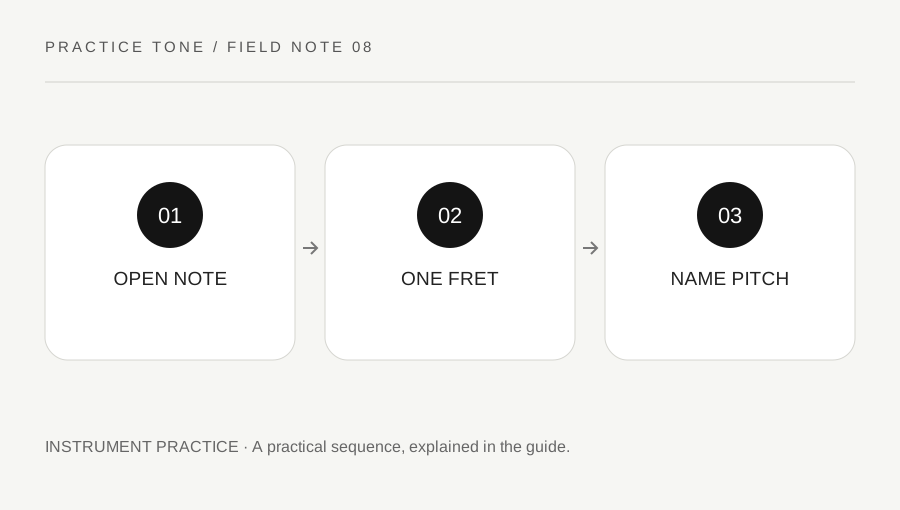
Original explanatory diagram. Numerical examples in this guide illustrate the reasoning; they are not a claim of hands-on testing.
State the tuning before naming notes
In standard six-string guitar tuning, the strings from lowest pitch to highest are E, A, D, G, B and E. This guide assumes that tuning. Alternate tunings change the starting note on a string, so a memorized fret label is not universal.
Choose one string and identify its open note. On the lowest E string, the first fret gives F, the second F-sharp or G-flat, the third G and so on. Each fret raises the pitch by one half step when moving toward the body along that string.
Do not confuse string order with physical height in an illustration. Many diagrams place the highest-pitched string at the top. Check the labels before interpreting the grid, and keep the guitar in a comfortable playing position rather than twisting your wrist to match a picture.
Remember where no accidental is needed
The letter sequence includes half steps between E and F and between B and C. There is no separate E-sharp fret between E and F; E-sharp is an alternative spelling for the pitch class F in equal temperament. Most other adjacent letter pairs have a sharp or flat pitch between them.
From open A, the first fret is A-sharp or B-flat, the second B, the third C, the fourth C-sharp or D-flat and the fifth D. Say the names slowly while playing only as fast as you can keep the sequence clear.
You do not need to press hard simply to learn the names. Use suitable instrument technique, pause if tension develops and seek a teacher's help if a clean note requires uncomfortable force. A note-naming exercise should not become an endurance challenge for the fretting hand.
Use the octave as a check
At the twelfth fret, a standard string produces the same letter name one octave above its open pitch. The twelve half-step positions complete the chromatic cycle before that repetition. An E string therefore reaches E again at fret twelve.
For a worked route, find G on the lowest E string at fret three, then continue twelve frets higher if your instrument and comfortable access allow. The later G is an octave higher. You need not physically reach every example to understand the naming pattern; written mapping is a valid part of the task.
The same named pitch can occur at several fretboard positions. That redundancy supports different voicings and fingerings, but it also means a note name alone does not specify one required string. Separate the pitch target from the chosen physical location.
Practice a small map and reverse it
Write the open note and the first five frets of one string. Check every transition by counting half steps. Then choose a target from that small map and find it without reciting the entire string aloud. Reverse the exercise by naming a fret and saying its note.
For standard tuning, the first five positions after open D are D-sharp/E-flat, E, F, F-sharp/G-flat and G. Explain why the move from E to F uses one fret, while D to E uses two.
Finish by comparing two strings at a familiar matching pitch, using a trustworthy tuning or instrument reference as appropriate. The browser explorer can play selected note relationships but is not a microphone tuner and does not confirm your guitar's tuning. Its purpose is connecting named pitches and intervals, while tuning and comfortable fingering remain separate tasks.
A practical checklist
Tick items for your own use. This checklist is saved only in this browser.
Questions that come up
Does this work in alternate tuning?
The half-step spacing along a standard fretted string still applies, but each string starts from its actual open pitch. Standard-tuning note maps must be adjusted.
Is the explorer a guitar tuner?
No. It generates reference notes and intervals without listening through a microphone. It does not measure your string pitch.
Must I memorize the whole fretboard at once?
No. Build a small accurate section, practice both naming directions and expand gradually while preserving the half-step logic.
References & scope
Background references checked on 18 October 2026. The examples and practice exercises are original editorial explanations, not copied procedures or professional advice.