Build Major and Minor Pentatonic Scales by Degree
A pentatonic scale uses five distinct pitch classes before the octave repeats. Build common major and minor forms from scale degrees, then practice a small phrase without assuming that a shape explains the notes.
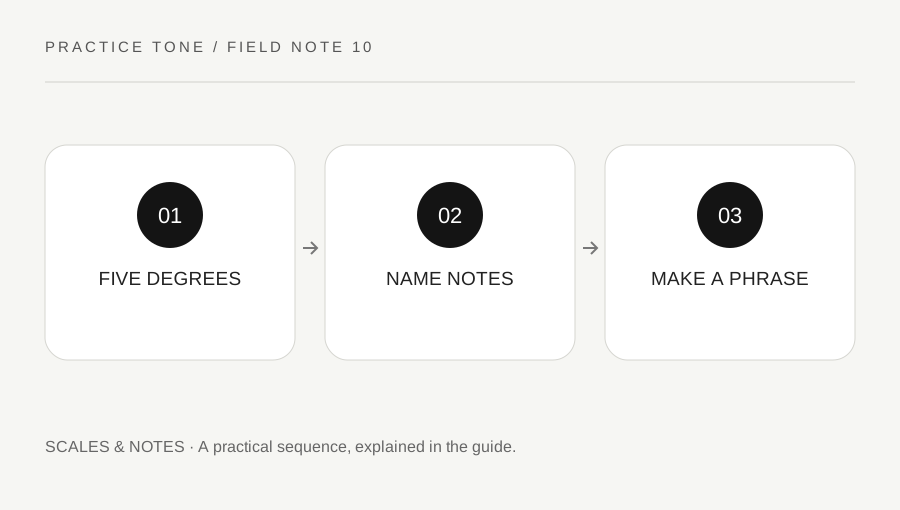
Original explanatory diagram. Numerical examples in this guide illustrate the reasoning; they are not a claim of hands-on testing.
Build the major pentatonic collection
The common major pentatonic uses degrees one, two, three, five and six of the major scale. From C major, that gives C, D, E, G and A, then C at the octave. The fourth and seventh degrees, F and B, are omitted from this particular collection.
Name the notes before playing. On piano, their physical spacing mixes adjacent and non-adjacent white keys. On guitar, many fingerings can represent the same collection in different registers. A familiar box pattern can support movement, but its outline alone does not explain which scale degrees you are using.
The tool does not include a separate pentatonic button. Display the relevant major scale and select the stated degrees as a written or instrument exercise. This limitation is deliberate and should not be confused with an unavailable automatic pentatonic generator.
Build the common minor pentatonic
The common minor pentatonic uses one, flat three, four, five and flat seven relative to the major-scale degree names. From A, the notes are A, C, D, E and G. You can also derive them from A natural minor by selecting degrees one, three, four, five and seven of that minor scale.
Be explicit about which reference system you are naming. Saying “third” without clarifying major or minor can obscure the interval. The A-to-C distance is a minor third, not the major third A-to-C-sharp.
A minor pentatonic and C major pentatonic share the same pitch collection, but they use different tonics and degree roles. This is similar to the relative relationship between A natural minor and C major. Returning to the chosen tonic helps the exercise communicate which collection you mean musically.
Practice a short original phrase
For C major pentatonic, try C–D–E–G–E–D–C using one note per beat. Keep the register and rhythm simple. Then make a second phrase, C–E–A–G–E–C, and listen for the return to C. These are original practice sequences, not excerpts from a copyrighted song.
For A minor pentatonic, use A–C–D–E–D–C–A. Compare the same physical note collection with a different starting and resting point. Do not assume that beginning on A once establishes a full tonal context in every piece; this is a controlled introductory exercise.
If you use guitar, choose a comfortable small area and identify the actual notes. Avoid stretching across a large diagram just to include every octave. Musical understanding can grow from a five-note register before expanding the fingering range.
Transpose the collection and check the degree names
Build G major pentatonic from G major: G, A, B, D and E. Build E minor pentatonic: E, G, A, B and D. Compare their shared notes and different tonic. Then construct D minor pentatonic as D, F, G, A and C.
Write the five degrees beside the note names and verify each distance. A missing fourth in the minor form or an added seventh in the major form changes the selected collection. It may still make a usable musical phrase, but it is no longer the exact exercise stated here.
Finish by varying only one feature of your original phrase, such as ending length or repeated note. A scale is material for making music, not a requirement to play every available note in order on each attempt. Keep a clear tonic, a manageable rhythm and an explanation of the chosen pitches as you explore.
A practical checklist
Tick items for your own use. This checklist is saved only in this browser.
Questions that come up
Does pentatonic always mean this one pattern?
No. The word broadly refers to five-note collections. This guide covers two common major and minor forms, not every pentatonic tradition.
Is there a pentatonic playback button?
No. Use the major or natural-minor display as a reference, then select the stated degrees on your instrument.
Can major and minor pentatonic share notes?
Yes. Relative forms such as C major pentatonic and A minor pentatonic share a collection while assigning a different tonic and functions.
References & scope
Background references checked on 18 October 2026. The examples and practice exercises are original editorial explanations, not copied procedures or professional advice.